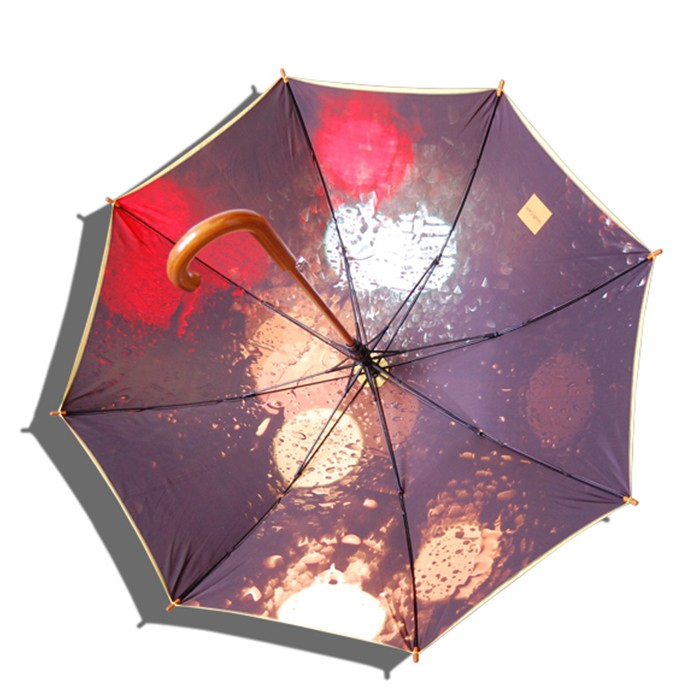
When buyers ask about umbrella manufacturing cost, they are often looking for a simple unit price. In reality, the cost of producing an umbrella depends on many small decisions: fabric, frame structure, ribs, opening system, printing method, packaging, order quantity, quality level, and shipping terms.
This is why two umbrellas that look similar in a product photo can have very different factory prices. A compact promotional umbrella with a basic polyester canopy is not costed the same way as a windproof golf umbrella with fiberglass ribs, double canopy construction, and full-panel printing.
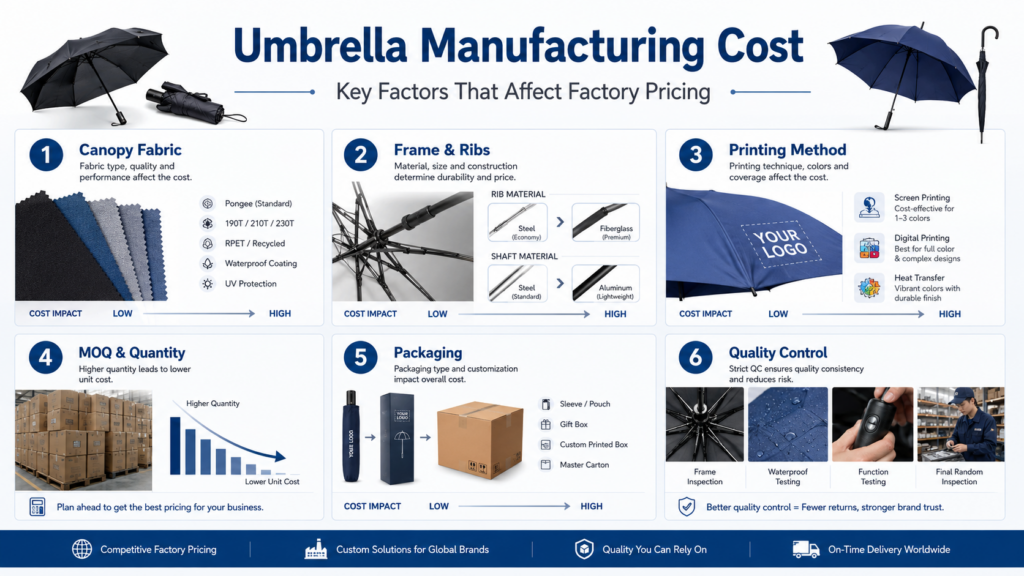
For importers, wholesalers, promotional product buyers, and brand sourcing teams, understanding cost structure is more useful than asking for the lowest possible price. It helps you compare supplier quotations fairly, avoid hidden compromises, and choose specifications that match your market.
What Does Umbrella Manufacturing Cost Include?
Umbrella manufacturing cost usually refers to the factory-side cost of producing the umbrella before international freight, import duty, local taxes, warehousing, and distribution.
Depending on the quotation term, the price may be shown as EXW, FOB, CIF, or another trade term. Buyers should confirm this clearly because a low factory price does not always mean a lower total sourcing cost.
In most umbrella projects, manufacturing cost includes:
- Canopy fabric
- Frame, shaft, ribs, tips, runner, and handle
- Cutting, sewing, assembly, and labor
- Logo printing or full-canopy customization
- Packaging materials
- Production loss and material wastage
- Factory overhead
- Basic quality inspection
- Supplier margin
It may not include international freight, customs clearance, import duties, destination charges, insurance, or special third-party testing unless these are specifically quoted.
Main Factors That Affect Umbrella Manufacturing Cost
Umbrella cost is not controlled by one single material. It is the result of several specifications working together.
1. Umbrella Type
The type of umbrella is one of the first cost drivers.
A small folding umbrella usually uses a more compact frame and less canopy fabric, but automatic open-close mechanisms can increase the cost. A straight umbrella may have a simpler structure but uses a longer shaft and larger packaging. A golf umbrella normally has a larger canopy, stronger frame, and more fabric, so it usually costs more than a basic promotional umbrella.
Common umbrella types include:
| Umbrella Type | Typical Cost Position | Main Cost Drivers |
|---|---|---|
| Compact folding umbrella | Low to medium | Folding frame, manual or automatic mechanism, sleeve |
| Straight umbrella | Medium | Shaft material, handle style, canopy size |
| Golf umbrella | Medium to high | Large canopy, strong ribs, windproof structure |
| Promotional umbrella | Low to medium | Quantity, simple logo printing, standard materials |
| UV protection umbrella | Medium to high | UV coating, black coating, fabric performance |
| Inverted umbrella | Medium to high | Special frame structure, double-layer canopy |
| Patio or outdoor umbrella | High | Large frame, heavy fabric, pole, base compatibility |
For sourcing teams, the most important point is simple: compare quotes only when the umbrella type and specifications are the same.
2. Canopy Fabric
The canopy is one of the most visible parts of an umbrella, so fabric affects both cost and perceived quality.
Common canopy fabrics include polyester, pongee, nylon, RPET fabric, PVC, and POE. For standard custom umbrellas, polyester and pongee are the most common choices.
Polyester is often used for practical promotional umbrellas because it is economical and widely available. Pongee usually feels smoother and more premium, which makes it popular for corporate gifts, retail umbrellas, and higher-grade custom orders.
Fabric density also matters. A buyer may see terms such as 170T, 190T, or 210T. In general, heavier or denser fabric can improve the hand feel and appearance, but it also increases material cost.
Additional fabric treatments can also affect cost, including:
- Water-repellent coating
- UV protection coating
- Blackout coating
- Silver coating
- PU coating
- Special color matching
- Recycled fabric options
- Higher colorfastness requirements
For a simple giveaway umbrella, a standard polyester canopy may be enough. For a brand, hotel, golf event, or retail project, a better fabric can make the product feel more reliable and worth keeping.
3. Frame, Shaft, and Ribs
The frame is one of the biggest differences between a cheap umbrella and a durable umbrella.
A very low-cost umbrella may use a basic metal frame. A stronger umbrella may use fiberglass ribs, reinforced joints, or a windproof construction. These upgrades increase manufacturing cost, but they also reduce the risk of breakage, returns, and poor user experience.
Important frame-related cost factors include:
- Steel, aluminum, fiberglass, or mixed-material frame
- Number of ribs
- Rib thickness and flexibility
- Manual open, auto open, or auto open-close mechanism
- Shaft material
- Runner quality
- Spring and button mechanism
- Windproof or double-canopy design
For folding umbrellas, the opening mechanism is especially important. Manual open umbrellas are usually more economical. Automatic open umbrellas cost more. Automatic open-close umbrellas cost even more because the internal mechanism is more complex.
For golf umbrellas, fiberglass ribs and a wind-resistant structure are often worth considering because the umbrella is expected to perform outdoors in stronger wind and rain.
4. Size and Canopy Coverage
A larger umbrella uses more fabric and usually requires a stronger frame.
For example, a 30-inch golf umbrella needs more canopy fabric than a 21-inch folding umbrella. Larger umbrellas also require bigger packaging cartons, which can increase freight volume.
Size affects:
- Fabric consumption
- Rib length
- Shaft strength
- Sewing time
- Printing area
- Carton size
- Shipping volume
Buyers should avoid comparing a 23-inch straight umbrella quote with a 30-inch golf umbrella quote. The product category, fabric usage, and frame strength are completely different.
5. Printing and Logo Customization
Customization is one of the most important cost factors in umbrella manufacturing.
A simple one-color logo on one panel is very different from full-canopy printing across all panels. The more complex the design, the more work is required before and during production.
Common umbrella printing methods include:
| Printing Method | Best For | Cost Impact |
| Screen printing | Simple logos, solid colors, bulk orders | Usually economical for simple designs |
| Heat transfer printing | Detailed logos, smaller designs | Medium cost |
| Digital printing | Complex artwork, gradients, photos | Higher cost |
| Dye sublimation | Full-panel or full-canopy designs | Higher cost, especially for all-over printing |
Screen printing is often used for standard logo umbrellas because it is practical for clean brand marks and simple color designs. Digital printing or sublimation is better when the artwork includes gradients, photos, detailed patterns, or full-surface designs.
Printing cost can increase because of:
- Number of print positions
- Number of colors
- Logo size
- Panel count
- Full-canopy artwork
- Color matching requirements
- Artwork preparation
- Printing setup
- Higher rejection risk for complex designs
If the goal is cost control, a one-color logo on one or two panels is usually more economical than a full-canopy design.
6. MOQ and Order Quantity
MOQ has a direct impact on umbrella manufacturing cost.
Many costs are fixed or semi-fixed, including artwork setup, printing preparation, material sourcing, machine setup, color matching, sampling, and production coordination. When the order quantity is small, these costs are spread across fewer units, so the unit price becomes higher.
When the order quantity increases, the factory can usually purchase materials more efficiently, reduce setup cost per unit, and improve production efficiency.
However, buyers should not only chase the lowest unit price. Ordering too much inventory can increase storage cost and cash pressure. The best order quantity should match the buyer’s sales channel, campaign plan, or distribution schedule.
7. Packaging Requirements
Packaging can be simple or highly customized.
A basic umbrella may use a polybag, matching sleeve, and export carton. A retail project may require hang tags, barcode stickers, branded sleeves, printed boxes, instruction cards, inner cartons, or special display packaging.
Packaging affects both manufacturing cost and shipping cost.
Common packaging options include:
- Individual polybag
- Matching fabric sleeve
- Custom printed sleeve
- Hang tag
- Barcode label
- Retail box
- Gift box
- Master carton
- Inner carton
- Palletized packing
For promotional campaigns, simple packaging is often enough. For retail, e-commerce, or corporate gift channels, better packaging may be necessary to protect the product and improve presentation.
8. Quality Control and Testing
Quality control is a real part of manufacturing cost.
A cheaper quotation may reduce cost by using lower-grade components, skipping inspection steps, or accepting higher defect tolerance. This can create problems after shipment, especially for importers and wholesalers who cannot easily repair or replace goods once they arrive.
Useful quality checks for umbrella production may include:
- Opening and closing test
- Frame strength check
- Rib alignment check
- Sewing inspection
- Fabric stain inspection
- Print position check
- Print adhesion check
- Water resistance check
- Handle and tip inspection
- Carton drop or packing inspection
For business buyers, quality control should not be treated as an optional extra. It protects the buyer’s brand, reduces complaints, and helps avoid costly after-sales problems.
9. Lead Time and Production Season
Lead time can also influence cost.
During peak rainy-season preparation or before large holiday campaigns, factories may have tighter production schedules. Rush orders may require overtime, faster material sourcing, or priority production, which can increase cost.
Cost may also change because of:
- Raw material price movement
- Exchange rate fluctuation
- Labor availability
- Factory capacity
- Shipping market conditions
- Seasonal demand
- Urgent delivery requirements
Planning earlier gives buyers more room to optimize cost, confirm samples, adjust packaging, and book shipping at a better time.
Umbrella Manufacturing Cost vs Landed Cost
A common mistake is to compare only factory unit price.
For importers and wholesalers, the more important number is landed cost. Landed cost is the total cost of getting the umbrella from the factory to the buyer’s warehouse or final destination.
Landed cost may include:
- Factory unit price
- Export packaging
- Inland transport
- Freight
- Insurance
- Customs clearance
- Import duty
- VAT or local tax
- Port charges
- Destination delivery
- Warehousing
- Inspection fees
An umbrella with a slightly higher factory price may sometimes have a better total cost if it is packed more efficiently, has fewer defects, or reduces after-sales risk.
Buyers should also confirm the correct HS code or customs classification with their freight forwarder or customs broker, especially when importing different umbrella types such as telescopic umbrellas, garden umbrellas, or umbrella parts.
Why Do Umbrella Quotes Differ So Much Between Factories?
Two factories may quote different prices for the same-looking umbrella because they are not always quoting the same product.
Here are common reasons:
| Quotation Difference | What It May Mean | What Buyers Should Ask |
| Lower fabric cost | Thinner fabric or lower-grade coating | What fabric type and density are used? |
| Lower frame cost | Weaker ribs or basic metal frame | What are the rib and shaft materials? |
| Lower printing cost | Smaller logo or fewer print colors | How many panels and colors are included? |
| Lower packaging cost | Basic bulk packing only | Is individual packaging included? |
| Lower unit price | Larger MOQ assumption | What quantity is the quote based on? |
| Short lead time | Existing stock or simplified customization | Is it stock product or full custom production? |
| Big price gap | Different quality standard | Can you provide full specifications and samples? |
A good supplier quotation should not only show price. It should clearly list specifications.
How to Request an Accurate Umbrella Quote
To get a useful quotation, buyers should provide clear product details from the beginning.
A complete request should include:
- Umbrella type: folding, straight, golf, inverted, patio, or other
- Size: arc size, open diameter, or panel size
- Frame material: steel, aluminum, fiberglass, or mixed frame
- Rib count: such as 8 ribs or other structure
- Opening system: manual, auto open, or auto open-close
- Canopy fabric: polyester, pongee, RPET, PVC, POE, or other
- Fabric color: standard color or Pantone matching
- Printing method: logo print, full-panel print, sublimation, or other
- Logo position: one panel, multiple panels, sleeve, handle, tie wrap
- Quantity: estimated order quantity and future repeat order plan
- Packaging: standard sleeve, custom sleeve, retail box, or gift box
- Shipping term: EXW, FOB, CIF, DDP, or other
- Destination country or port
- Target market: promotional, retail, corporate gift, hotel, outdoor, golf, or e-commerce
- Quality requirements: testing, inspection, compliance, or documentation needs
The more specific the request, the more accurate the quote will be.
How to Reduce Umbrella Cost Without Hurting Quality
Cost reduction does not always mean choosing the cheapest materials. A better approach is to simplify the product intelligently.
Here are practical ways to control cost:
Use Standard Umbrella Structures
A standard frame is usually more cost-effective than a fully customized structure. If the project does not require a special shape, choosing an existing umbrella model can reduce development cost and lead time.
Keep Logo Printing Simple
A one-color logo on one or two panels is usually more economical than full-canopy printing. If the design goal is brand visibility rather than artwork display, simple printing may be enough.
Choose the Right Fabric for the Market
For short-term promotions, standard polyester may be practical. For corporate gifts or retail channels, pongee or higher-grade fabric may create better value even if the unit cost is higher.
Avoid Too Many Color Variations
Multiple canopy colors, handle colors, or packaging versions can increase material preparation and production complexity. Reducing SKUs can help lower cost.
Plan the Order Earlier
Rush production often limits cost control. Earlier planning gives the factory more time to source materials, confirm samples, and arrange production efficiently.
Compare Complete Specifications, Not Just Unit Price
A lower quote may not include the same fabric, frame, printing area, packaging, or quality level. Always compare specification by specification.
When Should Buyers Pay More?
A higher umbrella manufacturing cost can be reasonable when the product needs better durability, stronger branding, or longer service life.
It may be worth paying more for:
- Golf umbrellas used in outdoor events
- Corporate gifts where brand image matters
- Retail umbrellas with packaging requirements
- UV protection umbrellas
- Windproof umbrellas
- Full-canopy printed umbrellas
- Hotel or hospitality umbrellas
- Repeat-use promotional campaigns
- Products sold under your own brand
For disposable giveaways, a basic specification may be acceptable. For brand-facing products, cutting too much cost can damage the buyer’s reputation.
Final Thoughts
Umbrella manufacturing cost depends on product structure, material choice, printing method, order quantity, packaging, and quality expectations. There is no single fixed price that applies to every umbrella project.
For sourcing teams and commercial buyers, the best approach is to define the product clearly before comparing quotes. A reliable umbrella supplier should be able to explain what is included in the price, where the main cost drivers are, and which specifications can be adjusted to meet your target budget.
The cheapest umbrella is not always the best value. A well-specified umbrella with stable quality, suitable packaging, and clear production terms often creates better long-term results for importers, wholesalers, and brand buyers.
FAQ
What affects umbrella manufacturing cost the most?
The biggest cost factors are umbrella type, canopy fabric, frame material, opening mechanism, printing method, order quantity, packaging, and quality requirements.
Why are custom umbrellas more expensive than stock umbrellas?
Custom umbrellas often require logo printing, artwork setup, material preparation, color matching, sampling, and separate production planning. These steps add cost compared with ready-made stock umbrellas.
Are folding umbrellas cheaper than golf umbrellas?
In many cases, basic folding umbrellas cost less than golf umbrellas because they use less fabric and have a smaller canopy. However, automatic open-close folding umbrellas can become more expensive because of their more complex mechanism.
Does full-canopy printing cost more than logo printing?
Yes. Full-canopy printing usually costs more because it requires larger artwork coverage, more precise panel alignment, and more complex printing work. A simple logo on one panel is usually more economical.
How does MOQ affect umbrella price?
MOQ affects how setup, printing, material sourcing, and production preparation costs are spread across the order. Lower quantities usually have a higher unit price, while larger orders can reduce the cost per umbrella.
What is the difference between factory cost and landed cost?
Factory cost is the cost of producing the umbrella. Landed cost includes factory price plus freight, customs clearance, import duties, taxes, destination charges, and delivery to the buyer’s warehouse.
Should buyers choose the lowest umbrella quote?
Not always. A very low quote may involve thinner fabric, weaker frame components, smaller printing area, basic packaging, or lower inspection standards. Buyers should compare full specifications before making a decision.
What information should I provide to get an accurate umbrella quote?
Provide umbrella type, size, fabric, frame material, opening system, printing artwork, logo positions, quantity, packaging requirements, shipping term, and destination country.